Showing posts with label Topps. Show all posts

Saturday, March 29, 2014

The 80s Begin

The early 80s may not have been significant for the Blazers in terms of wins or accomplishments, but it includes some of my favorite card sets, if for no other reason because they weren't especially prevalent and they include some of my favorite players.

The Blazers made Bahaman born Mychal Thompson the first pick in the 1978 draft.  Thompson averaged 20 points and 11 boards in the 81-82 season.

No player sported a cooler looking game necklace either...at least not until the 2000s when MLB pitchers started wearing them.
The early 80s also featured these 3 paneled basketball cards.  Were kids supposed to separate these and have miniature cards?  It's the polar opposite of the oversized cards of 1970.  In a decade, Topps has come full circle.  They still like their pink though.
The 1981-82 set included this nice team leader card though.  This may be my favorite Blazers uniform set as well, minus the short shorts.
The police cards continue.  Kermit Washington was a member of the team at this time, having joined the team following his release from the Los Angeles Lakers amid the punch scandal (google Kermit Washington punch...it's famous enough to not require repeating).

I included Kevin Kunnert for no reason other than because I played basketball with his daughter in the early 1990s.  Portland's a small community.
This 1983-84 Trail Blazer police card of Clyde Drexler is my earliest Drexler card.

Clyde...the best player in Trail Blazers history.  To watch him play, the guy could fly.  His jump shot always looked flat but it sure seemed to find the bottom of the net.
In the early 80s, the Star company came out with their series of basketball cards.  They were the only licensed NBA cards during the mid-80s.  This Jim Paxson was part of Star's 32 card set of star player cards, the only Blazer included in the inaugural set.  There were limited number of these cards, generally print runs of of less than 5,000.  Quality issues also caused less cards to be produced for Boston Celtics and Dallas Mavericks due to ink saturation.
Star cards were sold in hobby shops in team poly bags.  They were also distributed regionally, making collecting them difficult at the time.  Due to their limited production and distribution methods, most player cards from this era are not considered "true" rookie cards.

I never owned a Star card until I was an adult and the internet made acquisition of these cards more possible.  There is also something about their simplicity that is attractive.
The Franz baking company of Portland, Oregon also teamed up with the Star company for many years to produce Franz basketball cards which were included in loaves of bread.  During the time of year Franz basketball cards were coming out, I remember going to the grocery store with my mom every Sunday peering through the wrappers of Franz white bread sacks to see if there was a card I needed in there.

Oh yeah, also around that time the Blazers drafted Sam Bowie instead of Michael Jordan.  At the time, Portland had Drexler and didn't feel they needed another similar player.  Had Bowie lived up to his potential, this may not have seemed like such a monumental drafting error but Bowie (like Walton before him) was oft injured and seemed to keep breaking his legs.
At least we had these guys.  Jerome Kersey came out of small college Longwood and is to this day a Blazer fan favorite.  Hustle and a sweet mid range jumper.  Plus, is was so good looking in those black 80s shades.
Around this time, Portland also had Steve Colter as point guard.  He was never a great player but had an awesome 80s fro.  And Drexler was a slam dunking dream.
In the summer of 1984, Portland traded Fat Lever, Wayne Cooper, and Calvin Natt (3 solid players) and two draft picks to the Denver Nuggets for the jab-stepping Kiki Vandeweghe.  Kiki was a big time scorer for Portland along with Drexler for a few years, each averaging over 20 ppg.
This was no championship winning team but they had some great personalities and were exciting to watch.  Plus, it looked like things were headed in the right direction.

The Rest of the 70s

The rest of the 70s proceeded with the Blazers losing games.  The 1973-74 team had a league last record of 27-55.  They continued to be led in scoring by Geoff Petrie and Sidney Wicks (Topps cards pictured below).

However, their prospects were about to change with the draft of this guy out of UCLA:
They challenged for a playoff spot in Walton's first season, falling just 2 games short.

This was also one of Topps most iconic basketball card designs.  This rookie card of Bill Walton is one of my favorites of my whole collection.  It's simple, yet iconic.

Big Bill was hampered by injuries again in his sophomore season (this will become a common theme during his stint in Portland).  The Blazers again missed the playoffs.  However, they've started to put together the pieces of what will become NBA champs.
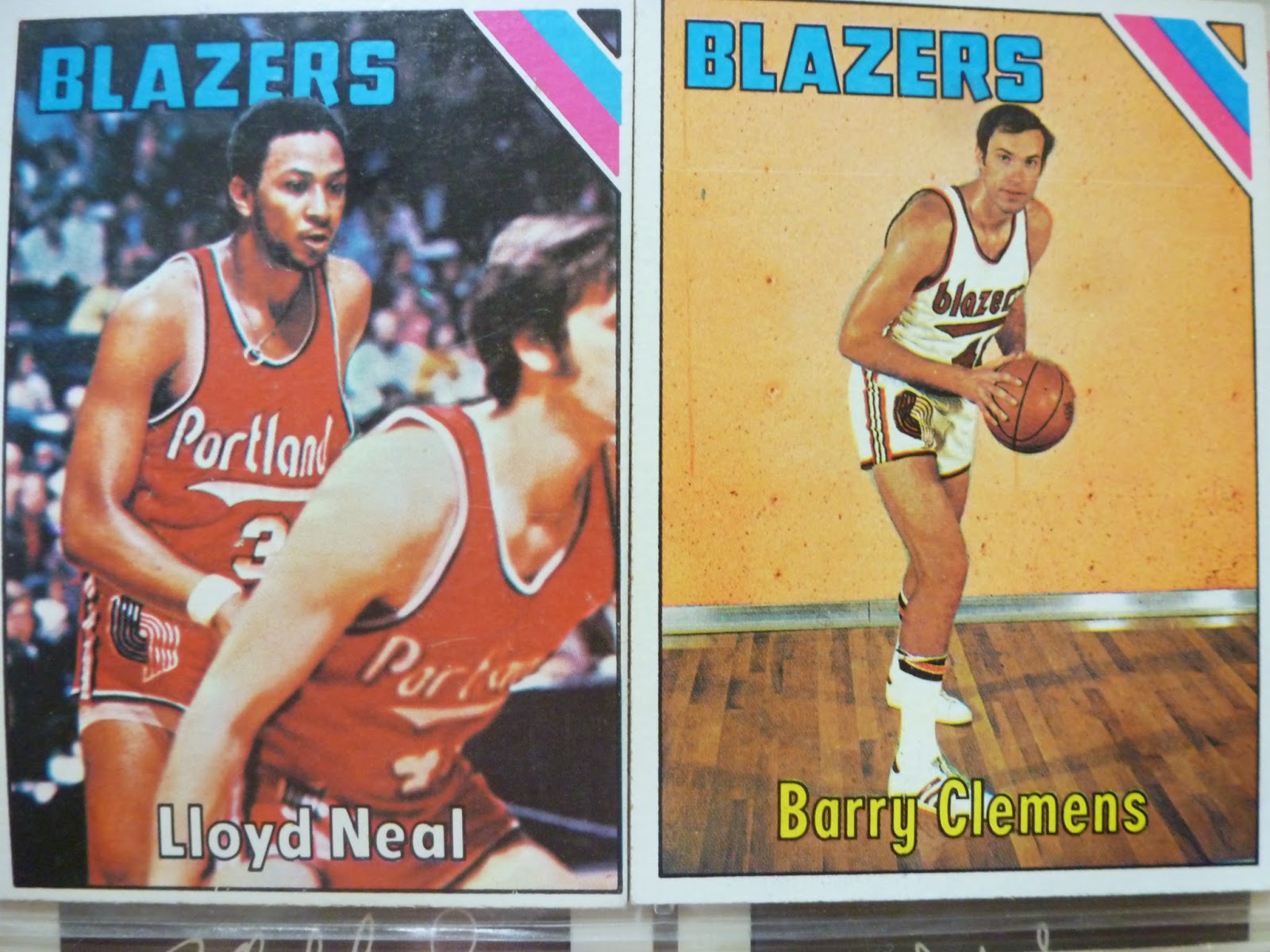
Well, maybe not Barry Clemens but he's included as it's an iconic pose from this year 1975-76 Topps.
And the token team photo.  I love these old team photos.  The red pants...the classic Blazers font...beautiful.

1976-77 Portland Trail Blazers.  First time in the playoffs.  Winners of the one and only Championship in franchise history.

I've watched the Championship winning game 6 against the Philadelphia 76ers multiple times.  I've grown to love Bill Walton, Bobby Gross, Lionel Hollins, Dave Twardzik, and Mo Lucas.  Their numbers hang from the rafters and they are the staple of this franchise.
Topps too decided it was time to go glossy and green.  This is the brightest set they've had to date which is fitting with this the brightest season in franchise history.

Unfortunately reality set back in following the team's championship season.  Injuries cost the team wins and they are unable to repeat their Championship win.  Bill Walton bailed for the San Diego Clippers and the team moved toward youth.

Topps decided pink trim was a way to go.  Pink trim with green letters.  However, the portrait inset is a nice addition.
The Blazers also put out police cards for several seasons.  The cards are on thinner paper than the typical sports card and a little bit larger.  Each card has team facts and crime fighting tips.

Sunday, November 24, 2013

The Not So Winning Years

1971-72 Blazers team won a mere 18 games, but rookie Sidney Wicks was named NBA Rookie of the Year.

Topps came out with what has to be my favorite card set of the 70's.  The colors are bright, the players stand out, and all in all the cards look great!  Now for a brief look at this team:

  • Geoff Petrie played college ball at Princeton. Petrie held the Blazer's single game scoring record of 51 until 2005.  His jersey #45 hangs in the Rip City rafters.  He has also been credited as the first NBA player to switch from Converse to Nike.  After retirement from the NBA, Petrie worked in the private sector for several years but went back to work in the Blazers offices in 1985.  He left Portland in 1994 and went to work for the Sacramento Kings as President of Basketball Operations.  He was replaced in Sacramento in June of 2013.
  • Claude English played his 18 game professional career for the Blazers.  He had one start at Buffalo where he played 20 minutes.  At present he is the director of athletics at Park University in Parkville, Missouri.


  • Shaler Halimon was drafted by the 76ers out of Utah State.  He joined the Blazers 4 games into their inaugural season in a trade from Chicago.  He appeared in all 79 games after coming to Portland and scored a career high 28 points versus Buffalo.  He was waived by the Blazers following the 1970-71 season.  Following basketball, Halimon worked many years as a bus driver for Tri-Met, Portland's metro transportation agency.

The 1972-73 managed to win 21 games, a slight improvement over the year before.  Topps also came out strong with another nice set, though not as nice as the year before.  The quirkiest thing about this set is that many of the depicted players are wearing their uniform's backward.
Lets talk players.


  • Sidney Wicks, as mentioned before, was drafted by the Blazers as the second pick in the 1971 draft out of UCLA after the Blazers paid the Cavs $250,000 not to draft him. He had a big year being named Rookie of the year and playing in the All-Star game (see card back below).  He played for Portland until 1976, serving as an All-Star 4 of those years.  He was sold to the Celtics in 1976.  Following basketball, he served as an assistant coach for 4 years at UCLA and later went into real estate.
  • Larry Steele played college ball at Kentucky under legendary coach Adolph Rupp.  He was selected by the Blazers's 37th overall in the 1971 draft. He joined the Trail Blazers at the start of the Blazers’ second season and became a roster mainstay for nine years before injuries forced him into retirement at the end of the 1979-80 season. His 610 games in a Portland uniform ranks sixth on the club’s all-time list.  His jersey was retired by the Blazers in 1981.  After retiring from pro basketball, he worked in the Blazers front office in marketing and served as a commentator with broadcaster Bill Schonely.  He was later head coach at the U. of Portland and currently runs a basketball camp in Vernonia, Oregon.

View of back of 1972-73 Topps card set:


  • Ron Knight was one of the original Blazers and one of the 2 rookies in the first ever Blazer starting lineup.  Knight played his entire 2 season NBA career for Portland.
  • Terry Dischinger played college ball for Purdue and won a gold medal in the 1960 Olympics.  Dischinger was NBA rookie of the year in 1962-63 with the Chicago Zephyrs.  Following his third NBA season, Dischinger served 2 years service in the U.S. Army.  He returned to basketball in 1967 and played for the Blazers during the 1972-73 season before retiring from the NBA.  Dischinger is currently an orthodontist in the Portland Metro area.  
It's worth noting that not only was Dischinger an orthodontist, he was my orthodontist. :-)

Saturday, November 16, 2013

1970 - 1971 Here Come the Blazers

As a lifelong fan of my hometown Portland Trail Blazers, a decade ago I began collecting basketball cards of my favorite team.  My collection is not about future inflation in value of pictures on cardboard but more to do with my enjoyment of the hunt and, more importantly, my love of this franchise.  This blog is intended to be an homage to the last 5 decades of the Blazers, it's players, and the basketball hobby, all in one.

Of course, there's no place to start but the beginning. The Blazers came into being in 1970 when the NBA board of governors granted Portland, through local area sports promoter Harry Glickman, a franchise for a $3.7 million admissions tax. To raise the money for the $3.7 million admission tax, Glickman associated himself to real estate magnates Bob Schmertz of New Jersey, Larry Weinberg of Los Angeles and Herman Sarkowsky of Seattle.  Two weeks later, on February 24, team management held a contest to select the team's name and received more than 10,000 entries. The most popular choice was "Pioneers," but that name was excluded from consideration as it was already used by sports teams at Portland's Lewis and Clark College. The name "Trail Blazers" received 172 entries, and was ultimately selected by the judging panel, being revealed on March 13 in the halftime of a SuperSonics game at the Memorial Coliseum. Derived from the trail blazing activity by explorers making paths through forests, Glickman considered a name that could “reflect both the ruggedness of the Pacific Northwest and the start of a major league era in our state.” Despite initial mixed response, the Trail Blazers name, often shortened to just "Blazers", became popular in Oregon.

Along with the Cleveland Cavaliers and Buffalo Braves (now Los Angeles Clippers), the Trail Blazers entered the NBA in 1970 as an expansion team, under coach Rolland Todd. Portland took the floor for the first time on October 16, 1970, and defeated Cleveland, 115-112. Guard Jim Barnett scored the first point in Blazers history by sinking a free throw at the 9:18 mark of the first quarter.

Portland ended it's first season with a 29-53 record, the best of the new expansion teams. Buffalo was 22-60, and Cleveland struggled at 15-67.
 
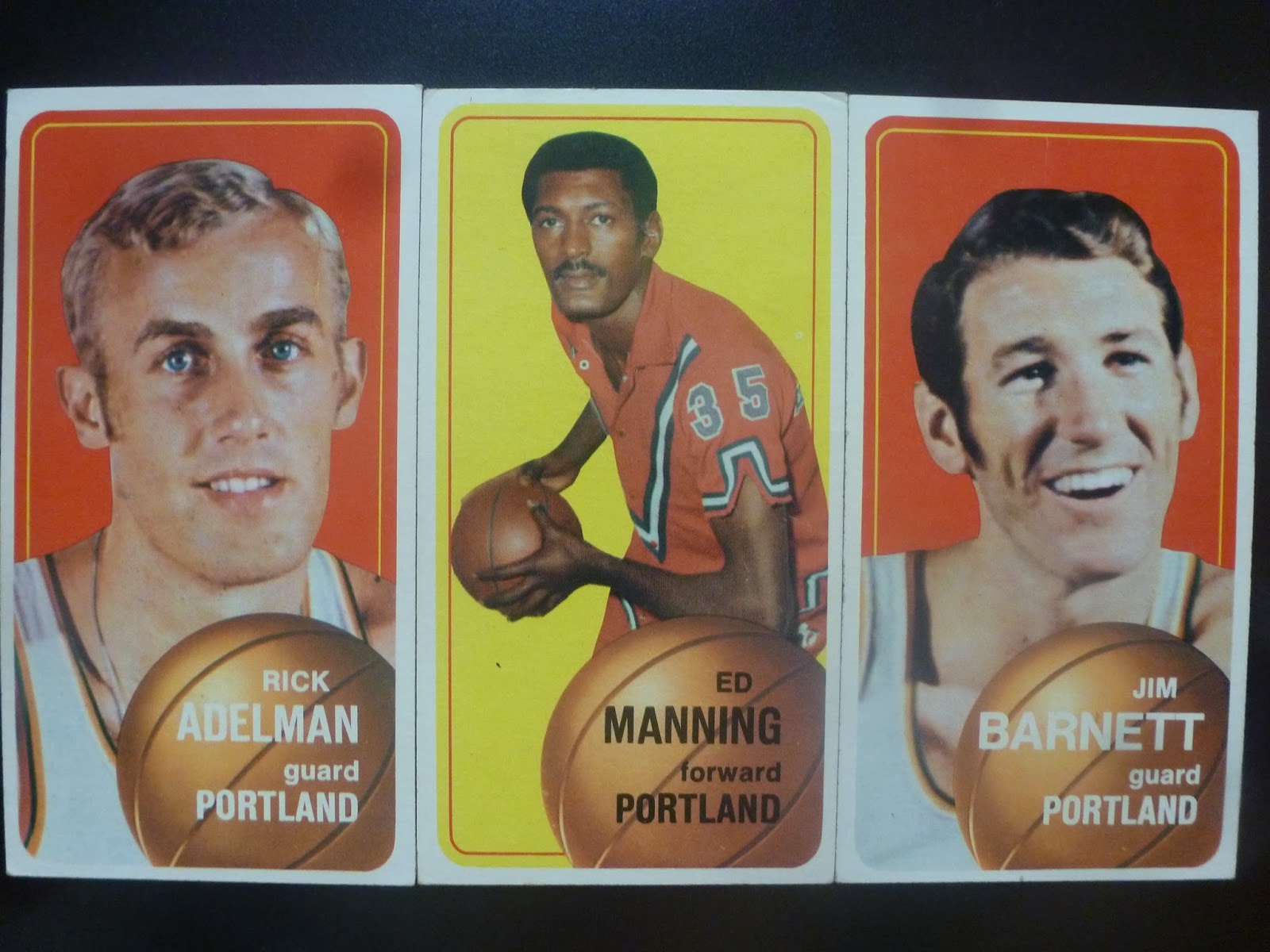
The 1970-71 Blazers were presented by Topps (Base set 175 cards (NBA) Size: 2½ × 4-11/16 in.)
 as follows:

  • Leroy Ellis was a 6'10" center from St. John's university.  Over the course of his career, Ellis recorded 10,176 points and 8,709 rebounds.  He joined the Blazers after being selected from Baltimore in the expansion draft and was in the starting lineup for Portland's first game.  He continued playing basketball long after his professional career ended, including being a part of several Senior Masters Games national championship teams in Portland.  Ellis died of prostate cancer on June 2, 2012, at the age of 72
  • Stan McKenzie was a small forward/guard who played college ball at NYU.  He was a durable player who played in all 171 games during his 2+ seasons with the Blazers.
  • Dorie Murrey was a 6'8" forward from Detroit who played just 2 games for the Blazers before being traded to Baltimore for a second round draft choice.


  • Gary Gregor was a 6'7" forward/center from UNC who missed the first 31 games of the Blazers inaugural season after tearing a knee ligament during training camp.
  • Dale Schleuter was a 6'10" center selected in the expansion draft from San Francisco.  Schleuter played back up to Leroy Ellis during the 1970-71 season.
  • Fred Hetzel is a 6'8" forward center from Davidson College and though his card denotes him as a Blazer, he didn't play a game for Portland.


  • Rick Adelman played college ball for Loyola in California.  He was selected by the Blazers in the expansion draft from San Diego and played 3 seasons for the Blazers.  Adelman is now more well known after coaching in the NBA successfully for 20+ years, currently with the Minnesota Timberwolves.  It's also worth noting that the Adelman family lived in our town growing up and I saw him frequently at school and sports functions.
  • Ed Manning, father of NBA star Danny Manning, was a Blazer for just the 1970-71 season but played 79 of the 82 games that year.  Manning has remained active in the NBA as an assistant coach and scout.
  • Jim Barnett, scorer of the Blazers first ever point (it was a free throw), was an All-American at the University of Oregon. Barnett is currently in his 27th year of broadcasting for the Golden State Warriors.
A remark on the cards themselves, these skinny and long cards were no doubt an attempt by Topps to reflect the height of basketball players and to differentiate the cards from their baseball and football versions.  The back of the cards all contain the requisite stats and blurbs, as well as a cartoon and "fun fact".  My favorite was that of Jim Barnett:


Course, back in the 1970's, players didn't make enough money from basketball and endorsements during the season so they had to supplement their income doing other jobs.  In Jim Barnett's case, that involved selling insurance.

And speaking of Jim Barnett, while playing for the Trail Blazers in 1971, Barnett attempted a rushed long-range shot against the rival Los Angeles Lakers. His shot went in, prompting Blazers play-by-play announcer Bill Schonely to exclaim "Rip City! All right!" The phrase "Rip City," the meaning for which Schonely has no explanation, nonetheless caught on and became synonymous with the team and the city of Portland.